
One of the most profound changes brought about by large language models (LLMs) isn’t simply that machines can now generate text, summarise documents or answer questions, it’s that, increasingly, we are willingly handing over parts of the process of thought...
“Improve this email.”
“Summarise this document.”
“Give me the key points.”
“Tell me what I should do next.”
Each request seems entirely reasonable, and usually it is; we tell ourselves that we are saving time. But there is an interesting paradox. As AI makes us more productive, the pressure on our time doesn’t necessarily decrease. Often the opposite happens. If something that previously took an hour can now be done in ten minutes, the expectation quickly becomes that we should simply do more.
So where is the balance?
What is the right level of increased productivity while ensuring that we remain a meaningful part of the process – critical thinking, questioning, challenging and ultimately making the decisions? Many companies, including those developing AI systems, talk about keeping the user in the driving seat. It sounds reassuring. But in a world of LLMs and increasingly agentic AI, do we really know what that means?
If an AI can interpret the request, decide which tools to use, execute multiple stages of a workflow, evaluate the results and determine what happens next, at what point is the human still driving? Is being asked to approve a result enough? Or does being in the driving seat mean understanding the assumptions being made, knowing when the AI has changed direction, being able to challenge its reasoning and deciding where human judgement must remain part of the workflow? These questions will become increasingly important as AI moves from answering questions to taking actions.
Aviation offers an interesting parallel
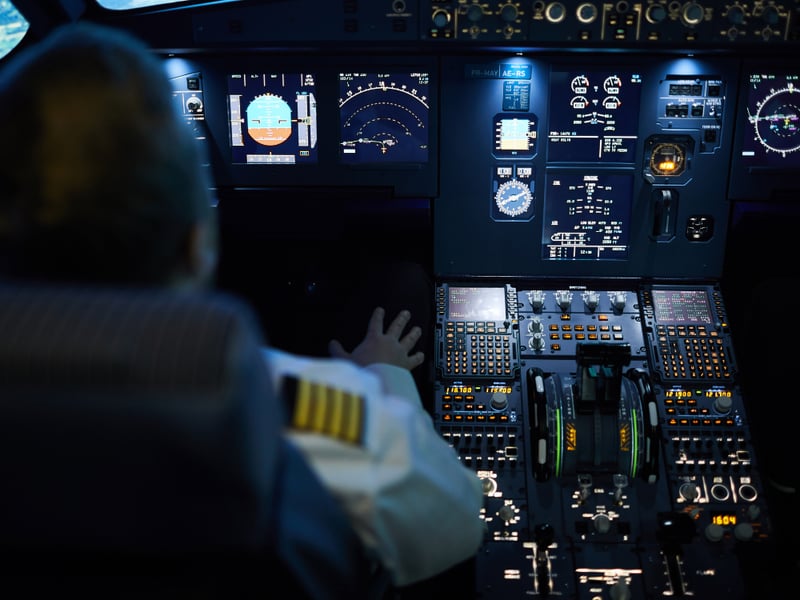
Dr James Lowell argues that keeping the human in the driving seat is not necessarily the same as simply keeping the human in the loop and makes a parallel to modern aircraft and autopilot.
Modern aircraft can automate large parts of a flight. But we haven’t concluded that the pilot therefore has no role. Instead, the role of the pilot has evolved. Automation can manage routine tasks with extraordinary speed and precision, while the pilot sets intent, understands the wider situation, monitors what the systems are doing and, critically, knows when to intervene.
But aviation has also taught us something else. If people become too dependent on automation, they can lose situational awareness and become less prepared to respond when something unexpected happens. That feels increasingly relevant to AI. The question isn’t simply how much of our work an AI can do. It is how much we should ask it to do while ensuring that we still understand what is happening, remain capable of challenging it and know when to take control.
Because keeping the human in the driving seat is not necessarily the same as simply keeping the human in the loop.
The opportunity with AI is not to automate everything that can be automated. It is to understand where the machine adds speed, scale and computational power, and where human experience, intuition, curiosity and judgement add something fundamentally different.
This is particularly important in geoscience. AI can analyse enormous seismic volumes, identify patterns, run models and increasingly orchestrate complex workflows. But understanding the subsurface is rarely just about finding an answer, it’s about understanding uncertainty, recognising what does not fit, challenging assumptions and combining evidence with geological insight.
At Geoteric, that is the journey we believe AI needs to take, AI that amplifies human ingenuity rather than replaces it. AI should remove friction from the workflow, it should take on repetitive work, connect information, explore possibilities and allow geoscientists to operate at a scale that would previously have been impossible.
But keeping the human in the driving seat must mean more than simply putting an approval button at the end of an automated process. The human should remain an active participant, able to question, intervene, understand why a decision was made, change direction and bring their own expertise to the result. Because perhaps the ultimate measure of successful AI isn’t how much thinking we can hand over to the machine, it’s how much more effectively human and machine can think together.
And perhaps there is a simple experiment hidden in this text - how dependent are we on AI: how many people will read this post it to the end, and how many will paste it into a LLM and ask, “Can you summarise this for me?".