
In Issue 2 of the European Association of Geoscientists and Engineers (EAGE) First Break magazine, Ciaran Collins and Abdulqadir Cader present an integrated fault interpretation workflow using multiple 3D deep learning convolutional neural networks (CNNs).
Accurate fault interpretation remains a critical component of subsurface characterisation, particularly in structurally complex settings where fault presence and geometry directly influence well placement and reservoir performance. Traditional workflows, while trusted, are slow and often subjective, especially when imaging is poor or faults exhibit subtle displacement. In challenging structural settings (as shown below) even small errors in fault geometry can lead to costly surprises during drilling.
In this paper Ciaran, Customer Support Geoscientist and Abdulqadir, Lead Geoscientist at Geoteric demonstrate how Geoteric 3D deep learning CNNs, optimised to detect different fault expressions in seismic data, enable a robust and comprehensive understanding of subsurface structure for well planning.
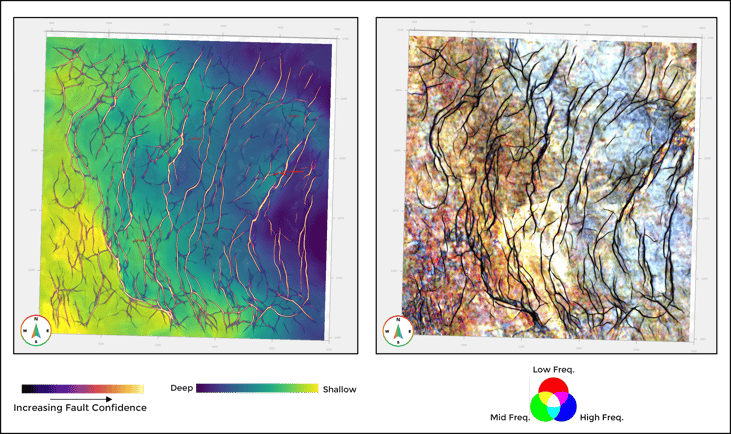
Left: Combined and optimised AI fault confidence volume over a TWT map along the Balder Fm. Right: High-definition frequency decomposition colour blend (Eckersley et al. 2018) and optimised AI fault confidence volume. Note how some frequency responses are structurally-bound.
Read the full paper in First Break magazine here.
Have a question? Get in touch! Contact us via email - info@geoteric.com.